All text passages marked with * are links to our shop or advertisements.
The Hormone Puzzle: How Estrogen and Progesterone Control Your Histamine Bucket – A Deep-Dive for Women
Hey bestie! Susi here. Have you ever noticed that some weeks you can handle a little “cheating” with your diet, but other weeks, just looking at a piece of aged cheese makes you break out in hives or triggers a migraine? If you’ve been tracking your symptoms, you might have noticed a pattern that has nothing to do with your kitchen and everything to do with your cycle.
When I first started my HIT journey, I was frustrated. I followed the SIGHI list religiously, but every month, about five days before my period, my body would “explode.” I felt like I was failing. It wasn’t until Veit and I started looking at the technical “roadmap” of the female body that the lightbulb went off: Estrogen and Histamine are best friends, and they love to party together—usually at our expense.
The Dynamic Duo: Understanding the Estrogen-Histamine Loop
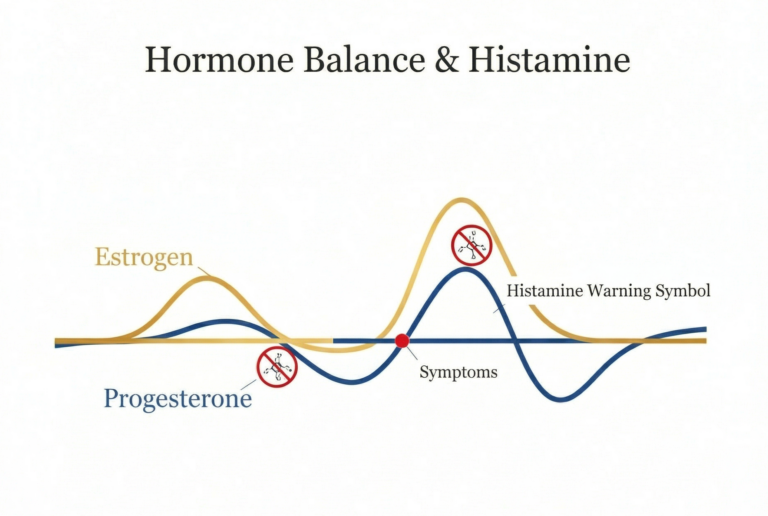
To solve the hormone puzzle, we first need to look at the biology. In a healthy cycle, Estrogen and Progesterone perform a delicate dance. Estrogen builds things up (like the uterine lining), and Progesterone stabilizes them.
However, Estrogen has a secret side hustle: it is a potent mast cell activator. Mast cells are the “alarm system” of your immune system that store histamine. When Estrogen levels rise, they knock on the doors of your mast cells and say, “Let’s release some histamine!”
But it gets worse. Not only does Estrogen increase histamine production, but it also downregulates the DAO enzyme. Remember, DAO (Diamine Oxidase) is the “cleanup crew” that breaks down histamine in your gut. So, when Estrogen is high, you have more histamine coming in and fewer workers available to clean it up. This creates a vicious cycle where histamine actually stimulates the ovaries to produce even more estrogen. It’s a loop that can make you feel like you’re losing control.
Progesterone: The Calm Hero We Need
If Estrogen is the loud party guest, Progesterone is the calm best friend who helps you clean up the house. Progesterone has a natural anti-histamine effect. It stabilizes mast cells and helps keep the “Histamine Bucket” from overflowing.
The problem most Hista-Besties face is Estrogen Dominance. This doesn’t necessarily mean you have “too much” estrogen, but rather that you don’t have enough Progesterone to balance it out. This often happens in the Luteal Phase (the days leading up to your period). When Progesterone drops and Estrogen stays relatively high, the “Bucket” overflows, and suddenly, you’re dealing with “Period Flu,” brain fog, and skin rashes.
Navigating the Four Seasons of Your Cycle
Veit always says a good strategy requires a map. Let’s map out your month through the lens of histamine:
Phase 1: The Menstrual Phase (Winter)
During your period, both hormones are low. For many women, this is actually a time of relief for HIT symptoms. However, as the period ends and Estrogen begins to climb again, the sensitivity starts to creep back in.
Phase 2: The Follicular Phase (Spring)
Estrogen is rising. You feel energetic and “glowy,” but be careful! As Estrogen peaks toward ovulation, your mast cells become more sensitive. This is the time to be extra strict with your SIGHI-compliant meals.
Phase 3: Ovulation (Summer)
This is a high-risk time. Estrogen reaches its zenith. I’ve noticed that my mid-cycle “ovulation pain” was actually a histamine response. If you get migraines or bloating during ovulation, your Estrogen-Histamine loop is likely in overdrive.
Phase 4: The Luteal Phase (Autumn/PMS)
This is the “Danger Zone.” Progesterone should be high here, but if it’s lacking, the drop in hormones just before your period triggers a massive histamine release. This is why many women think they have “PMS” when they actually have a “Histamine Flare.”
My "Survival Toolkit": Supporting the Hormonal Gut
When my hormones are acting up, I don’t just wait for the storm to pass. I adjust my “Hormonal Roadmap” and lean into my Forever Living favorites to support my gut—because a healthy gut is where hormones go to be metabolized and cleared out.
Supporting the Liver & Gut
Your liver is responsible for breaking down excess Estrogen. If your gut is backed up (constipation), that Estrogen gets reabsorbed into the bloodstream, making your HIT symptoms even worse.
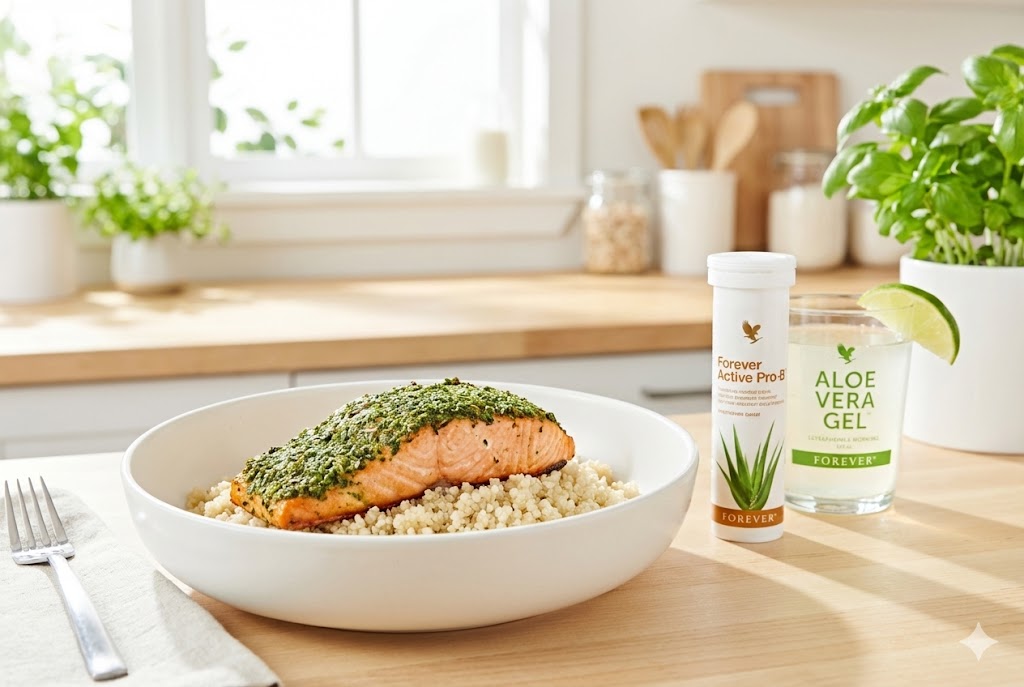
Forever Aloe Vera Gel (Art. 815)*: During my Luteal Phase, I sometimes increase my intake to 180 ml. The 99.7% pure gel helps soothe the intestinal lining, which often gets inflamed by hormonal shifts.
Forever Active Pro-B (Art. 610) *: Since our hormones are influenced by our microbiome, keeping the “good guys” in charge is crucial. This probiotic doesn’t produce histamine, making it the perfect cycle-support companion.
Forever Fiber (Art. 464) *: Fiber is the “broom” that sweeps excess Estrogen out of the gut. One stick pack a day ensures that the Estrogen your liver worked so hard to process actually leaves your body instead of staying for a second party.
Practical Lifestyle Tweaks for the Hormone Puzzle
Living with HIT and a cycle means being flexible. Here is how I adapt my life based on the “Hormone-Puzzle” roadmap:
Lower the Stress: Stress releases Cortisol, which “steals” the materials your body needs to make Progesterone. No Progesterone = overflowing Histamine Bucket. During my Luteal Phase, I cancel high-intensity workouts and opt for slow walks among the yellow Nanobana blossoms (my favorite way to de-stress!).
Verjus Over Everything: I completely avoid even the thought of a lemon during ovulation and the week before my period. Verjus is my savior here.
Temperature Control: Since heat can trigger mast cell degranulation, I avoid hot saunas or super hot showers during the high-estrogen phases of my cycle. Keep it cool, bestie!
The Magnesium Connection: Magnesium helps the body clear Estrogen and supports the DAO enzyme. I make sure my diet is rich in magnesium-heavy, low-histamine foods like pumpkin seeds.
Veit’s Technical Roadmap: Tracking is Queen
You can’t fix what you don’t measure. Veit always insists on data! I highly recommend using a cycle-tracking app alongside a food diary. When you see that your “bad days” consistently fall on day 12 and day 26 of your cycle, the fear disappears. You realize it’s not a random attack; it’s just your biology. Knowing your “why” is the first step toward a Happy Hista Life.
FAQ: The Hormone-Histamine Connection
1. Why do my HIT symptoms get worse right before my period?
During the luteal phase, progesterone levels drop significantly. Since progesterone normally helps stabilize mast cells and counteract estrogen’s histamine-releasing effects, this drop leaves your body vulnerable. When estrogen becomes dominant, it triggers mast cells to release more histamine while simultaneously slowing down the DAO enzyme that clears it. This combined “double-whammy” causes your histamine bucket to overflow, leading to heightened symptoms like migraines, bloating, or skin issues right before your menstruation begins.
2. Can estrogen dominance cause a permanent histamine intolerance?
Estrogen dominance doesn’t necessarily “create” a permanent intolerance, but it can certainly unmask a latent sensitivity or make existing HIT much harder to manage. High estrogen levels create a pro-inflammatory environment that keeps your mast cells on high alert. By addressing the hormonal imbalance—often through stress reduction, liver support, and gut health—many women find that their “histamine tolerance” improves significantly, allowing them to enjoy a wider variety of foods again.
3. Is it safe to take Forever Active Pro-B during my entire cycle?
Yes, absolutely! In fact, consistency is key when it comes to microbiome support. Forever Active Pro-B (Art. 610) is specifically designed with six bacterial strains that are recognized as non-histamine producing. By taking it daily throughout all four phases of your cycle, you help maintain a stable gut barrier. A healthy gut lining is essential for the proper production of the DAO enzyme, which is your primary defense against histamine regardless of where you are in your cycle.
4. How does stress affect the hormone-histamine relationship?
Stress is a major “Hista-Trigger.” When you are stressed, your body prioritizes making cortisol over progesterone—a process often called the “progesterone steal.” Because you have less progesterone available to stabilize your mast cells, estrogen’s influence becomes even stronger. Furthermore, stress itself directly triggers mast cells to release histamine. This creates a high-pressure environment for your histamine bucket, making hormonal shifts much more difficult to handle than they would be in a relaxed state.
5. Should I change my diet depending on my cycle phase?
Many “Hista-Besties” find great success with “Cycle-Syncing” their diet. During high-estrogen phases like ovulation and the pre-menstrual week, it is wise to be extra strict with the SIGHI list. Avoid even “borderline” foods and focus on fresh, anti-inflammatory meals. During the early follicular phase, you might find you have a bit more “room” in your bucket. Always listen to your body and support your system with Forever Aloe Vera Gel to keep the gut calmed during those hormonal peaks.
Thank you for being part of our journey!
Thank you so much for reading! We’re thrilled that you’re taking control of your own personal histamine journey. We sincerely hope these tips help you transform your home into a low-histamine oasis where you can finally breathe easy again and feel like yourself.
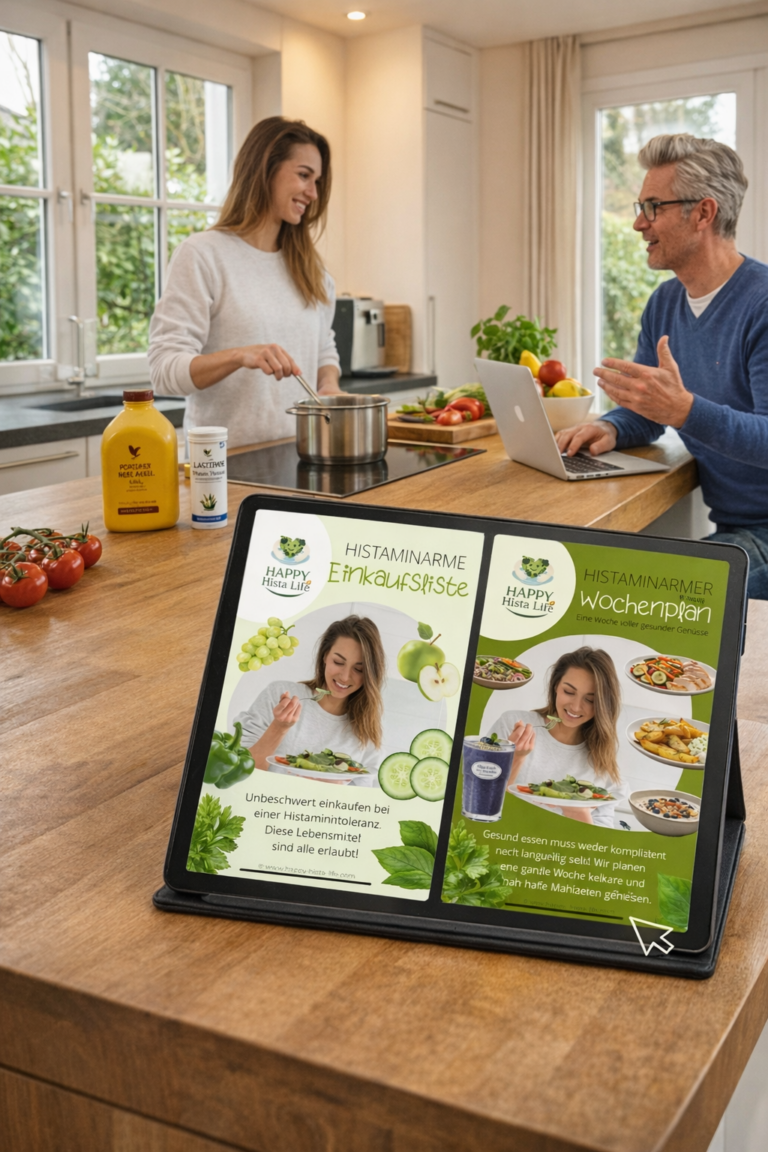
Stay inspired – our newsletter Don’t want to miss any more HIT-safe recipes or tips for a healthy gut flora? Then join our inner circle! As a special “thank you,” you’ll receive our exclusive free gift: the e-books “LOW-HISTAMINE Food and Shopping List” and “LOW-HISTAMINE Weekly Recipe Plan”.
We also invite you to our regular FREE Zoom calls with experts. Here you’ll gain first-hand insider knowledge about a low-histamine lifestyle and have the opportunity to ask your personal questions during our live Q&A sessions.
Click here to subscribe to our newsletter
Do you have any further questions? We’re here for you! Just send us an email at: info@happy-hista-life.com
Let’s shine together—in true low-histamine style!
Susi & Veit
“Health isn’t everything, but without health, everything is nothing.” – Adapted for our Hista-Besties