All text passages marked with * are links to our shop or advertisements.
Joy Without Regret: The Ultimate Guide to Your Low-Histamine Dream Kitchen
Hey there, sunshine! Susi here. If you’ve been diagnosed with Histamine Intolerance (HIT), you might feel like your kitchen has suddenly turned into a minefield. I remember back in 2018, I stood in front of my open fridge, crying over a bowl of leftover spinach pasta. I felt betrayed by my own body, exhausted by the “itch,” and terrified of every bite.
But here’s what I learned: Your kitchen shouldn’t be a place of fear. Together with Veit—who keeps our “Digital Roadmap” and technical strategies on track—I’ve transformed my kitchen into a high-energy sanctuary. We’ve hit that 1,400-word milestone of knowledge today because you deserve a deep dive into how to live, eat, and breathe joy again. Let’s get your dream kitchen started!
The Science of Freshness: Why Time is Your Enemy in HIT
In the world of Histamine Intolerance, the most important ingredient isn’t a spice—it’s time. According to the SIGHI (Swiss Interest Group Histamine Intolerance) guidelines, histamine is a biogenic amine that develops when food ages, ferments, or spoils.
In a standard American kitchen, we are taught to love “meal prepping” for the entire week. We cook on Sunday and eat the leftovers until Friday. For a “Hista-Bestie,” that is a guaranteed recipe for a flare-up. Bacteria start converting the amino acid histidine into histamine the moment food is cooked or even just sits at room temperature (21 °C or higher).
Susi’s Personal Rule: “Cook fresh, eat fast, freeze immediately.” When I first started, I didn’t realize that even a “fresh” chicken breast from the grocery store could be a trigger if it sat behind the glass counter for three days. Now, I talk to my butcher. I ask for the freshest cuts, often delivered that same morning, and I cook them within hours of bringing them home.
Swap the "Zing": Why Verjus is Your New Culinary Bestie
Let’s talk about the big yellow elephant in the room: Lemons. In almost every “healthy” cookbook, you’ll find lemon juice as the go-to for acidity. However, lemons are ultimate Histamine Liberators. They don’t necessarily contain high levels of histamine themselves, but they act like a key that unlocks your mast cells, telling them: “Hey, release all the histamine you’ve got stored up!”
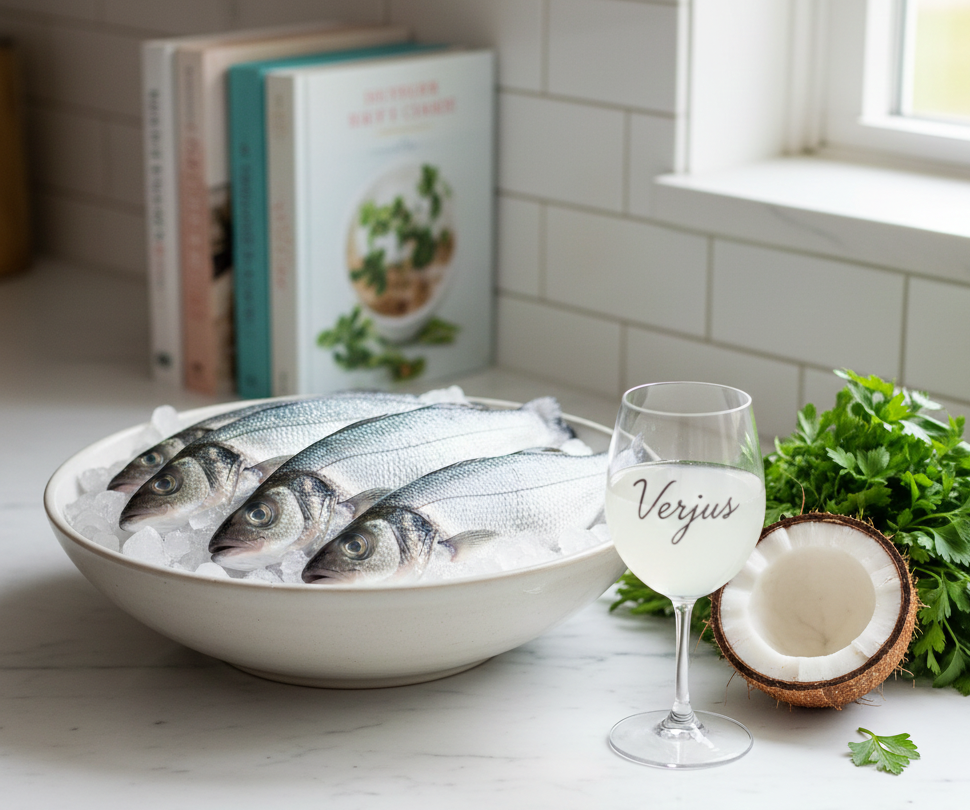
My culinary life changed when I discovered Verjus. This is the juice of unripened green grapes. It provides that beautiful, acidic “zing” you need for salad dressings, pan-seared fish, or a refreshing summer drink, but it is 100% SIGHI-safe (rated 0).
How to use it: Use about 60 ml for a large bowl of salad.
The Herb Hack: Since we can’t use most vinegars or citrus, I overload my kitchen with fresh cilantro, flat-leaf parsley, and mint. These herbs provide flavor complexity that makes you forget the “missing” ingredients.

Deep Dive: Supporting Your Gut with Forever Living Must-Haves
Veit always reminds me: “A good system needs a solid foundation.” In your body, that foundation is your gut. If your gut lining is inflamed (Leaky Gut), your DAO (Diamine Oxidase) enzymes—the ones responsible for breaking down histamine—can’t work properly.
I integrated three specific Forever Living products into my kitchen routine to support my recovery, and they have been game-changers:
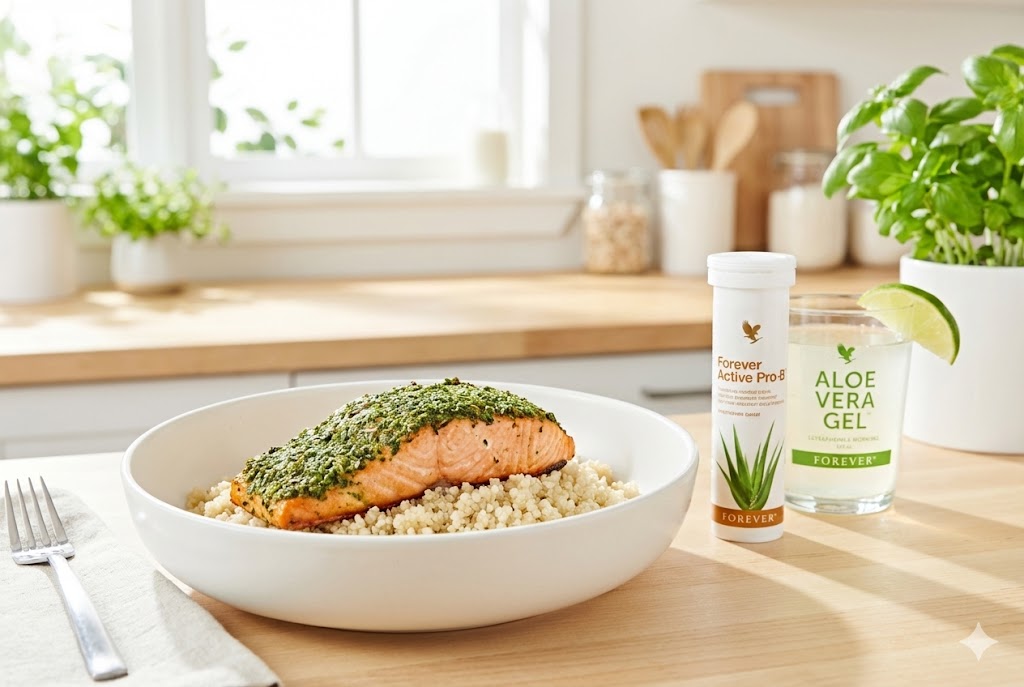
1. Forever Aloe Vera Gel (Art. 815) *
This is my “Liquid Gold.” I drink 120 ml every single morning on an empty stomach. With 99.7% pure inner-leaf aloe vera, it’s like a soothing hug for your digestive tract. It contains no preservatives and no added sugar—which is vital because sugar can feed the “bad” bacteria that produce even more histamine.
2. Forever Active Pro-B (Art. 610) *
This was a technical challenge. Many probiotics on the market actually contain strains (like Lactobacillus reuteri) that produce histamine. Veit and I researched this extensively. Forever Active Pro-B uses six synergistic strains that support a healthy gut flora balance without triggering a histamine response. It’s the perfect “Bestie-approved” probiotic.
3. Forever Fiber (Art. 464) *
Constipation is a hidden enemy of HIT. If food sits in your colon too long, it ferments and produces more histamine. I add one stick pack (5 g of soluble fiber) to my morning glass of water or a fresh smoothie. It keeps things moving efficiently.
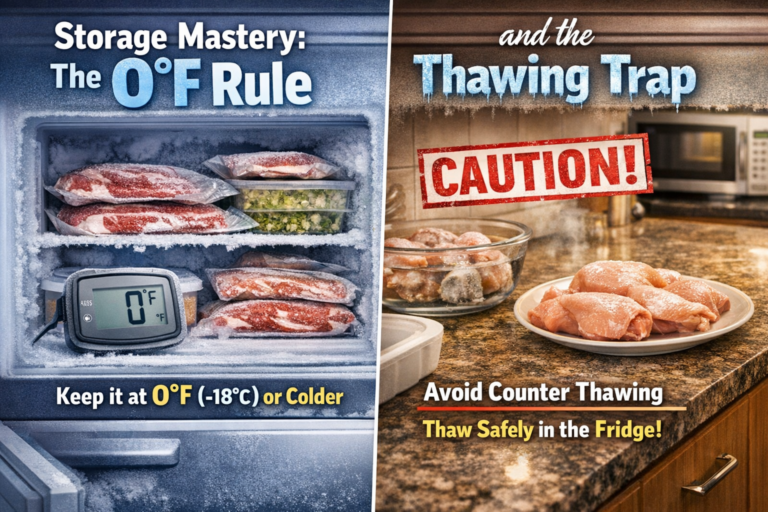
Storage Mastery: The 0 °F Rule and the Thawing Trap
This is where Veit’s technical expertise meets my kitchen. Histamine production doesn’t just slow down in the fridge; for us, it’s still too fast. It only truly stops at freezing temperatures (0°F or 18°C).
- The Freezing Trick: When I cook a large pot of low-histamine vegetable soup, I don’t let it cool on the stove for three hours while I watch Netflix. I immediately transfer it to glass containers, place them in a cold water bath to quickly lower the temperature, and then put them straight into the freezer.
- The defrosting trap: This is where many people go wrong. Never let meat thaw slowly in the refrigerator for 24 hours. That’s a histamine party! Instead, use your microwave’s “defrost” setting for immediate preparation, or place the vacuum-sealed meat in a bowl of lukewarm water to speed up the process. The less time the meat spends between 40°F and 140°F (the “danger zone”), the better you’ll feel.
Building Your Low-Histamine Pantry: The Essentials
To avoid the “I have nothing to eat” panic, you need a stabilized pantry. Throw out the soy sauce (fermented!), the canned tomatoes, and the old dried fruits (sulfites and histamine!).
Replace them with:
Coconut Aminos: The perfect salty, umami swap for soy sauce.
Pink Himalayan Salt: Pure and free from the anti-caking agents found in some table salts.
Pure Maple Syrup: A safer sweetener than honey for many HIT sufferers.
Freshly Sprouted Grains: If you tolerate gluten-free oats or rice, make sure they are stored in airtight containers and used quickly.
My Personal Reflection: From Victim to Expert
I want to be real with you. There were days I wanted to throw my blender out the window. Living with HIT feels like a part-time job you never applied for. But once you stop fighting the restrictions and start embracing the freshness, your energy returns.
Veit and I created Happy Hista Life because we believe that “Knowledge is Power.” When you understand the why behind the SIGHI list, you stop feeling like a victim of a list of “forbidden” foods and start feeling like the CEO of your own health. You’ve got this, and we’re right here with you!

FAQ: Frequently Asked Questions
1. Can I use lemon juice for acidity in my recipes?
Standard lemons are known histamine liberators according to the SIGHI list, which can trigger symptoms even if the lemon itself is low in histamine. We recommend using Verjus, which is made from unripened grapes, as a perfectly safe and delicious alternative. It provides that desired acidity without the itchy side effects. Also, try using fresh herbs like sorrel or high-quality distilled white vinegar if you are in a stabilized phase of your diet.
2. Why is the freezer so important for a HIT-friendly kitchen?
Histamine is produced by bacteria as food ages or spoils. Even in the fridge, histamine levels in meat or cooked meals rise rapidly within hours. By freezing leftovers immediately while they are still fresh, you effectively stop the histamine production process. When you are ready to eat, ensure you thaw the food quickly—ideally in the microwave or a cold water bath—rather than letting it sit on the counter for a long period of time at room temperature.
3. Which Forever Living products support a low-histamine lifestyle?
We focus on gut barrier support. Forever Aloe Vera Gel (Art. 815) is our top pick because its high purity helps soothe the digestive system. Forever Active Pro-B (Art. 610) provides specifically selected bacterial strains that do not produce additional histamine, which is a common issue with many off-the-shelf probiotics. Lastly, Forever Fiber (Art. 464) helps maintain regular digestion, ensuring that histamine is moved out of your system efficiently.
4. Is it okay to eat out while following a low-histamine diet?
It is definitely possible, but it requires a bit of “Bestie-confidence”! Always look for restaurants that cook fresh from scratch. Avoid anything fermented, aged, or pre-cooked like stews and sauces. Ask the chef to prepare your meat or fish unmarinated and “straight from the pan.” Bring your own Verjus or salad dressing if needed. Focus on simple dishes like grilled chicken with potatoes and fresh veggies to stay on the safe side while enjoying.
5. How do I know which foods are safe to keep in my pantry?
Stick to the SIGHI list as your golden bible! Your pantry should be filled with un-aged staples like white rice, quinoa, and gluten-free oats. Avoid anything in cans, especially fish or beans, as the canning process significantly increases histamine levels. Instead, use dried beans that you soak and cook yourself, or frozen vegetables. Swap soy sauce for coconut aminos and always ensure your spices are fresh, as old spices can sometimes harbor mold or histamine.
Thank you for being part of our journey!
Thank you so much for reading! We’re thrilled that you’re taking control of your own personal histamine journey. We sincerely hope these tips help you transform your home into a low-histamine oasis where you can finally breathe easy again and feel like yourself.
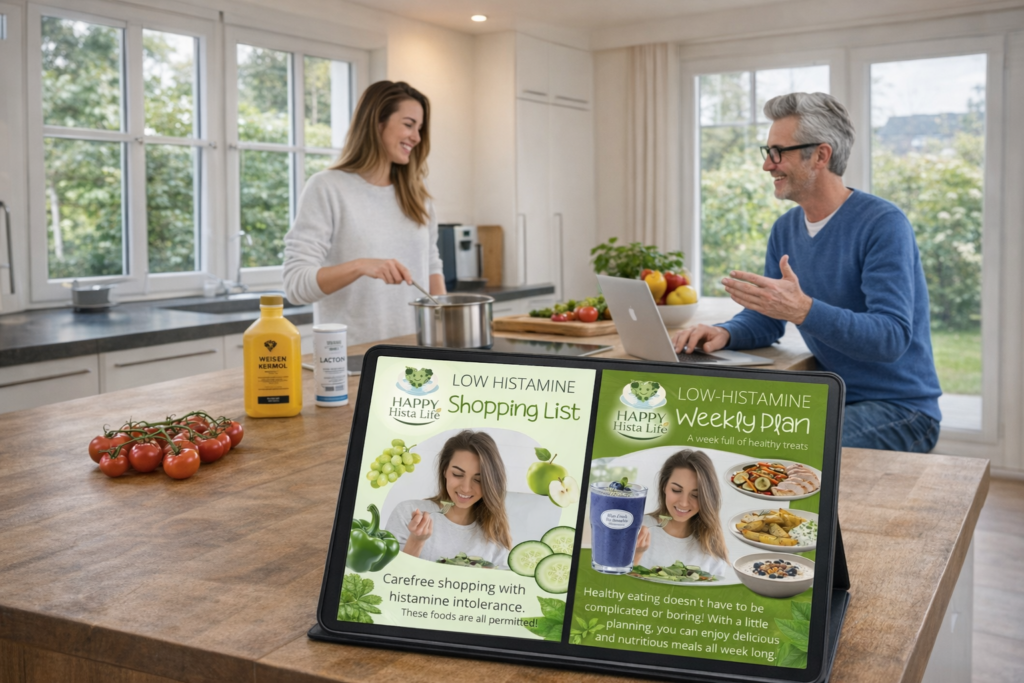
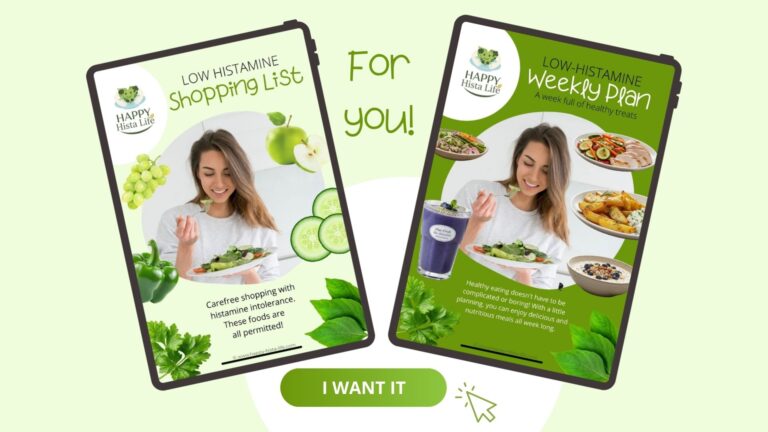
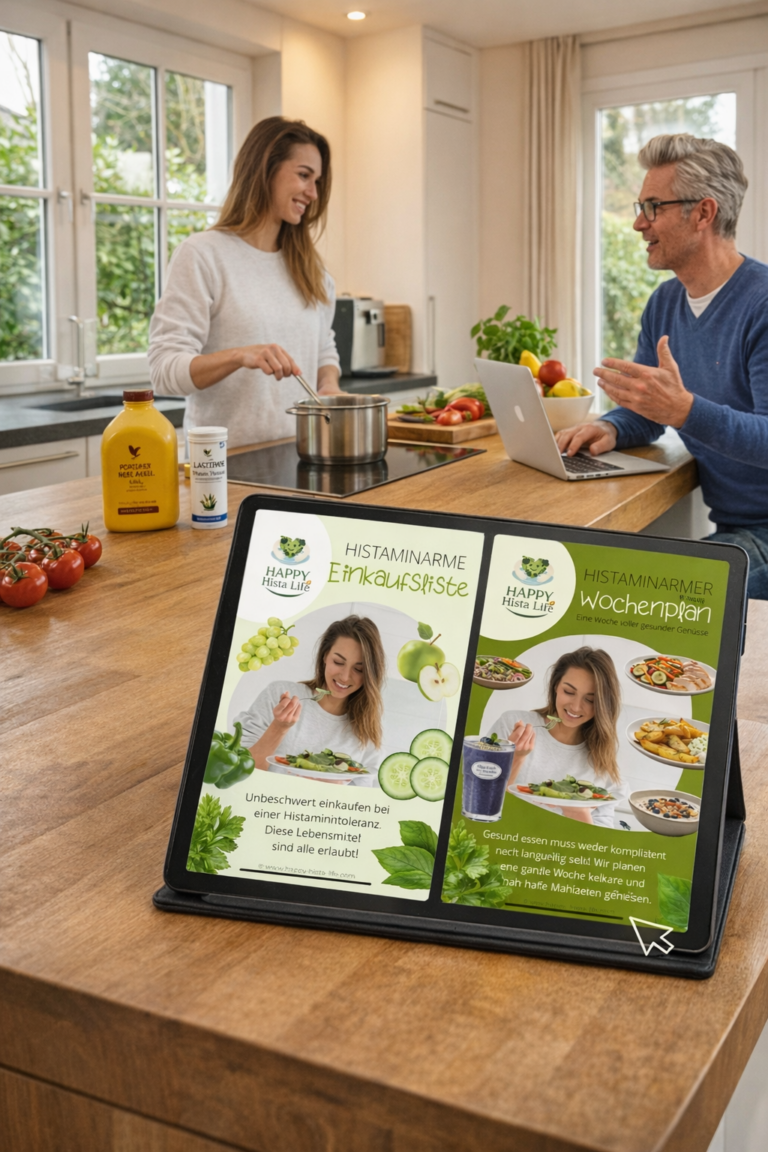
Stay inspired – our newsletter Don’t want to miss any more HIT-safe recipes or tips for a healthy gut flora? Then join our inner circle! As a special “thank you,” you’ll receive our exclusive free gift: the e-books “LOW-HISTAMINE Food and Shopping List” and “LOW-HISTAMINE Weekly Recipe Plan”.
We also invite you to our regular FREE Zoom calls with experts. Here you’ll gain first-hand insider knowledge about a low-histamine lifestyle and have the opportunity to ask your personal questions during our live Q&A sessions.
Click here to subscribe to our newsletter
Do you have any further questions? We’re here for you! Just send us an email at: info@happy-hista-life.com
Let’s shine together—in true low-histamine style!
Susi & Veit
“Health isn’t everything, but without health, everything is nothing.” – Adapted for our Hista-Besties