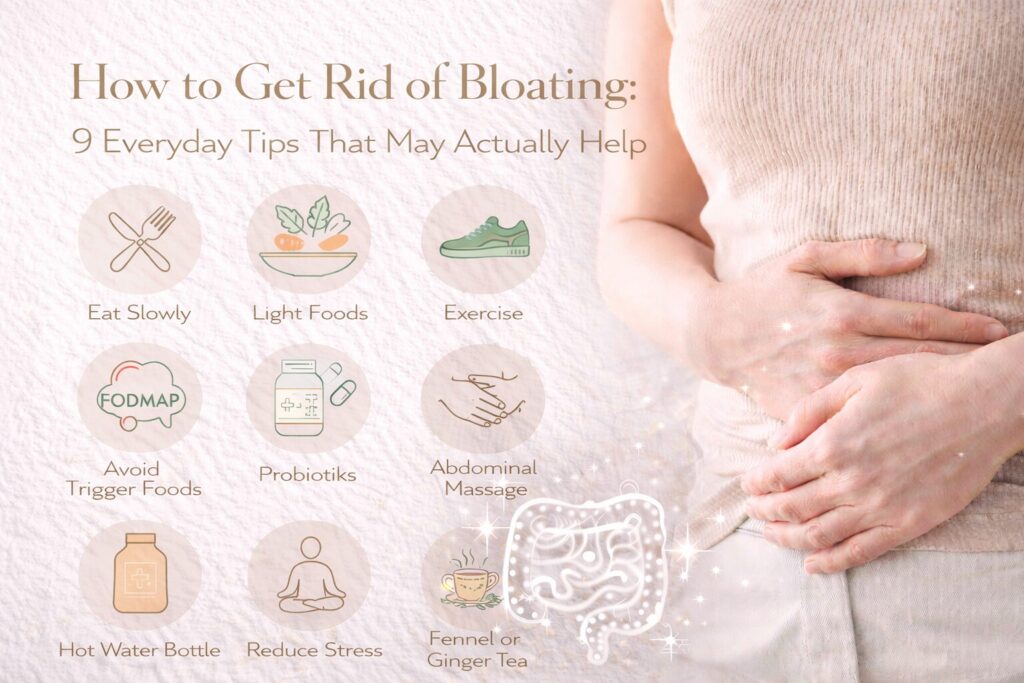
How to Get Rid of Bloating: 9 Everyday Tips That May Actually Help

Bloating is common, annoying, and often surprisingly disruptive. NHS describes bloating as a very common problem where your tummy feels full, uncomfortable, or bigger than usual, while NIDDK lists bloating, distention, belching, and passing gas as common gas-related symptoms. Some gas is normal, especially during or after meals, but symptoms become more relevant when they happen often, bother you, or interfere with daily life.

The slightly irritating truth is that bloating usually does not respond to one dramatic fix. NIDDK says reducing gas symptoms often starts with swallowing less air, changing eating and drinking habits, adjusting diet, or using medicines or supplements when appropriate. In other words, everyday habits usually matter more than flashy “gut hacks.”

Why bloating happens in the first place

According to NIDDK, gas in the digestive tract mainly comes from swallowed air and from bacteria in the large intestine breaking down undigested carbohydrates. NHS also notes that bloating may be linked to constipation, food intolerance, coeliac disease, IBS, or eating foods that are harder for some people to digest. That is why a bloated stomach is sometimes just temporary digestive irritation and sometimes a clue to a bigger pattern.

1. Eat more slowly and swallow less air

One of the simplest forms of bloating relief is slowing down when you eat. NIDDK specifically recommends swallowing less air as part of reducing gas symptoms. That makes sense: rushed meals, fast drinking, and constantly eating on the go can all make your digestive system work harder than it needs to. Not glamorous advice, but often useful advice.

2. Try smaller meals instead of very large ones

Large meals can make bloating feel worse simply because your gut has more to manage at once. While NHS guidance focuses more broadly on digestive comfort and identifying triggers, this fits the overall recommendation to change eating habits when symptoms keep happening. For a sensitive stomach, “less at once” is often more helpful than “more discipline tomorrow.”

3. Cut back on fizzy drinks and common trigger foods for a while

NHS lists fizzy drinks among common contributors to bloating and also points to constipation, food intolerance, and IBS as possible reasons symptoms flare up. On the NHS IBS advice page, foods that may worsen bloating, cramps, and farting include cabbage, broccoli, cauliflower, Brussels sprouts, beans, and onions. That does not mean these foods are bad. It means some guts are less cooperative around them than others.

4. Consider constipation as part of the problem

A bloated stomach is not always “just gas.” NHS explicitly says constipation can cause bloating, and IBS guidance also notes that constipation can be part of the symptom pattern. So if you feel swollen, heavy, or full and your bowel habits are also off, treating the constipation angle may matter more than chasing random anti-bloating tricks.

5. Move your body regularly

Movement is one of the more boring suggestions, which is unfortunately part of why it works. NHS includes lifestyle measures as part of digestive support, and broader medical guidance consistently links physical activity with better bowel function and digestive regularity. A short walk after meals may be more useful than many dramatic online remedies that sound clever but solve nothing.

6. Oats and linseeds may help some people

For people with IBS-style bloating, NHS specifically recommends eating oats regularly and having up to 1 tablespoon of linseeds a day to help ease bloating, cramps, and farting. That is refreshingly practical. It is also a good reminder that sometimes the more useful advice sounds suspiciously ordinary compared with the usual supplement marketing opera.

7. Watch out for sorbitol and sugar-free products

NHS also advises people with IBS symptoms to avoid products containing sorbitol, a sweetener that can worsen bloating and gas for some people. This is one of those details many miss because they are focused on meals and forget about “healthy” extras like sugar-free gum, mints, or low-sugar products. Sometimes the problem is not dinner. Sometimes it is what keeps tagging along all day.

8. Pharmacy options can help in the short term

NHS says a pharmacist can advise on medicines that may help with bloating, including simeticone, and the IBS advice page also mentions options such as Buscopan or peppermint oil for some people. That is not a cue to medicate your way through every digestive complaint forever. It is simply useful to know that bloating does not always have to be endured in noble silence.

9. Do not assume bloating is always harmless

By itself, bloating is often not serious, and Mayo Clinic notes that gas and bloating often improve with simple changes. But both Mayo Clinic and NHS say medical advice is important when symptoms are severe, persistent, or paired with warning signs. These include vomiting, diarrhea, constipation, unintentional weight loss, blood in the stool, or symptoms that do not go away. That is the point where “I’ll just wait it out” stops being a clever plan.
Common mistakes people make with bloating

A common mistake is changing everything at once and then having no idea what actually helped. Another is ignoring the possibility of constipation, IBS, or food-related triggers and treating every bloated day like a random fluke. NIDDK recommends targeted changes to eating and drinking habits rather than vague guesswork, and NHS repeatedly points to persistent or frequent symptoms as something worth taking seriously.

A practical way to start today

A sensible starting point is surprisingly plain: eat more slowly, reduce fizzy drinks for a while, and add some regular movement. If constipation may be part of the picture, pay attention to fluids and bowel habits too. These kinds of simple changes line up much better with mainstream medical guidance than the usual internet fantasy that one powder, tea, or supplement will instantly fix everything.

MY HEARTFELT RECOMMENDATION:

Why Forever Living Was a Game-Changer for Me

My dear friends, when we talk about gut health, we can’t ignore the quality of what we put into our bodies. Especially with histamine intolerance (HIT), our gut is often a sensitive “hotbed of trouble.” I searched for years and finally found the purity my body accepts with Forever Living. Why? Because Forever doesn’t just process aloe vera—it brings it to life—from the plant directly into the product, without unnecessary fillers or artificial additives.

Here are my three personal staples for your routine:

  • Clean 9 (C9)*: My reset button! It’s not a diet, but a cleanse from the inside. It helps the body let go of the old and reset the microbiome—perfect for increasing histamine tolerance again.
  • Aloe Vera Gel (Item 815)*: The “yellow gold.” With 99.7% pure leaf pulp, it’s like a gentle hug for your intestinal lining. Important for us: It contains no added citric acid, which could trigger us. A shot glass full (approx. 3.4 fl. oz.) in the morning works wonders.
  • Forever Active Pro-B (Item 610)*: Probiotics are often tricky with HIT, but this formula with six synergistic bacterial strains is a godsend. It helps restore balance without causing the histamine barrel to overflow.

The products are linked to my shop if you’re interested.

FAQ

What helps bloating quickly?

Quick bloating relief often starts with very basic changes: eat more slowly, avoid fizzy drinks for a while, choose smaller meals, and pay attention to whether constipation may be involved. NHS also notes that a pharmacist can advise on medicines such as simeticone for symptom relief. Fast relief is useful, but if bloating keeps coming back, your daily eating habits and triggers usually matter more than one short-term fix.

Which foods can make bloating worse?

Common triggers can include fizzy drinks and, for some people, foods such as cabbage, broccoli, cauliflower, Brussels sprouts, beans, and onions. NHS also highlights sorbitol as a possible problem for people with IBS-related bloating. That does not mean these foods are universally bad. It means some people tolerate them poorly, especially when symptoms are already active or digestion is generally sensitive.

When should I see a doctor about bloating?

It is worth getting medical advice if bloating is severe, keeps coming back, does not improve, or happens alongside warning signs such as vomiting, diarrhea, constipation, blood in the stool, unintentional weight loss, or ongoing pain. Mayo Clinic and NHS both flag those as reasons not to keep guessing. At that point, it is no longer just an annoying stomach issue that deserves endless self-experiments.

Can constipation cause bloating?

Yes, definitely. NHS explicitly lists constipation as a common cause of bloating, and IBS guidance also shows how constipation and bloating can appear together. That is why it helps to look at the bigger digestive picture instead of only focusing on trapped gas. If bowel movements are hard, infrequent, or incomplete, treating that pattern may reduce the swollen, full, uncomfortable feeling as well.

Do oats and linseeds help with bloating?

They can help some people, especially when bloating is part of an IBS-style symptom pattern. NHS specifically recommends eating oats regularly and having up to 1 tablespoon of linseeds a day to ease bloating, cramps, and farting. That is not a guarantee for every stomach, but it is a much more grounded suggestion than many generic “gut health” claims floating around online.


Final thoughts

When people ask how to get rid of bloating, the real answer is usually not one miracle trick. It is a mix of slower eating, smaller and more manageable meals, identifying triggers, moving more, and knowing when symptoms deserve proper medical attention. The gut can be sensitive. It does not, however, need to be dramatic full-time.

Leave a Comment

Your email address will not be published. Required fields are marked *